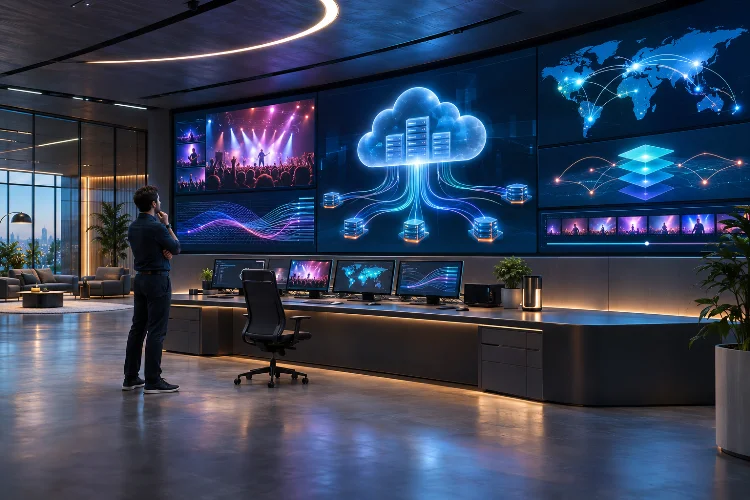
When a digital concert goes live, audiences don’t care how many servers are working behind the scenes. They care that the stream starts quickly, the chat feels lively, and the biggest moments reach everyone without freezing.
Yet a sudden traffic spike can expose weak infrastructure within seconds. Advanced Cloud Architecture gives entertainment teams a practical way to handle these unpredictable moments.
By combining global routing, low-latency streaming, edge delivery, and real-time communication, platforms can support large audiences while keeping their experiences responsive.
The challenge is making these technologies work together without creating unnecessary complexity.
Why Real-Time Entertainment Needs a Different Cloud Approach
Traditional websites can often tolerate a short delay when loading images or refreshing content.
Real-time entertainment has much stricter expectations because audiences experience technical problems immediately.
Imagine a live gaming tournament where viewers receive match results before the video shows the winning moment.
Even a few seconds of difference can spoil the excitement.
Modern entertainment infrastructure must coordinate video delivery, application requests, and interactive features without forcing every service to behave identically.
For example, a video streaming system might prioritize efficient distribution, while an audience voting service needs fast response processing.
Separating these responsibilities makes the platform easier to optimize.
It also prevents one demanding activity from consuming resources needed by unrelated features.
Building Low-Latency Streaming Infrastructure
Video streaming is often the most demanding component of a large digital entertainment experience.
Delivering high-quality footage to thousands of viewers requires efficient encoding, reliable transport, and carefully selected playback technology.
Choosing Between Broadcast and Real-Time Streaming
Amazon Interactive Video Service offers low-latency streaming capabilities designed for delays under five seconds.
Its real-time stages can support latency below 300 milliseconds under suitable conditions.
These capabilities serve different purposes.
A virtual concert with 50,000 viewers might prioritize scalable broadcasting, while a smaller interactive discussion requires faster communication between participants.
Actual delays depend on network conditions, device performance, and streaming configurations.
Choosing the appropriate delivery model prevents developers from building unnecessarily expensive solutions.
The goal is matching latency requirements to how audiences actually interact.
Using Edge Networks to Improve Global Delivery
Audiences watching the same entertainment event may live thousands of kilometers apart.
Sending every request to a single distant server can introduce avoidable network delays.
Edge delivery helps distribute content closer to viewers.
Combining CDN Technology With Adaptive Streaming
Cloudflare Stream supports global video distribution and adaptive bitrate playback through formats including HLS and DASH.
Adaptive streaming allows compatible players to select video quality based on available network capacity.
For example, someone watching through a strong broadband connection might receive a high-resolution stream.
Another viewer using mobile data may receive a lower-resolution version to reduce buffering.
However, a CDN doesn’t automatically solve every performance issue.
Application APIs, authentication services, and real-time messaging still require appropriate infrastructure.
Static assets such as interface images and scripts can also benefit from caching, while personalized responses need more careful cache rules.
This helps reduce unnecessary traffic toward the main application servers.
Designing Multi-Region Application Infrastructure
Global entertainment platforms frequently serve users from several continents simultaneously.
A backend deployed in only one region may provide acceptable performance locally but respond more slowly to distant audiences.
Multi-region deployment can help address this problem.
Routing Requests Through Global Load Balancing
Google Cloud supports global external Application Load Balancers that can distribute HTTP and HTTPS traffic across backends in multiple regions.
This allows applications to direct eligible requests toward appropriate infrastructure.
For example, an online entertainment platform could deploy services in Asian, European, and North American regions.
Users may experience faster responses when their requests are handled closer to their locations.
However, distributing applications introduces new challenges.
Authentication, user sessions, and shared information must remain consistant across deployments.
Teams should carefully decide which data requires global synchronization and which operations can remain regional.
Synchronizing Video With Interactive Features
Live entertainment increasingly includes polls, audience reactions, quizzes, and interactive overlays.
These features create opportunities for participation, but synchronization becomes challenging when video playback delays differ.
Using Timed Metadata for Interactive Moments
Amazon IVS supports timed metadata embedded within video streams.
This allows compatible applications to trigger specific actions when playback reaches a particular moment.
Imagine a digital music competition where viewers must vote after watching a performance.
Without synchronization, some participants might receive voting prompts before they finish watching.
Timed metadata can help align the prompt with the relevant video content.
However, the voting service must still process submissions independently.
Developers should also account for delayed messages, reconecting users, and possible network failures.
A dependable design treats media synchronization and application state as related but distinct responsibilities.
Preparing Infrastructure for Sudden Audience Growth
Entertainment traffic rarely follows a perfectly predictable pattern.
A regular livestream might attract 2,000 viewers, while a surprise celebrity appearance brings 25,000 additional participants.
Cloud infrastructure must accommodate these bursts.
Automatic scaling can increase application capacity when demand rises, but scaling decisions require more than monitoring CPU usage.
For example, a rapid increase in connected viewers might overload authentication services before video distribution reaches its limits.
Teams should test registration, playback startup, chat, and interactive features simultaneously.
A hypothetical platform expecting 30,000 viewers could evaluate performance at that level and under additional stress.
Cloud quotas and database connection limits also need attention.
Maintaining sufficient spare bandwith and computing capacity helps reduce the risk of failures during important moments.
Monitoring the Actual Viewer Experience
A streaming dashboard might show healthy servers while audiences continue experiencing playback problems.
That’s why technical monitoring should include measurements from the viewer’s perspective.
Useful indicators include video startup time, buffering frequency, playback errors, and application response times.
Connecting Performance Data With Audience Behavior
Imagine an esports broadcast where viewers in one geographic region report delayed video loading.
Regional monitoring could reveal whether the problem originates from network conditions, application services, or the streaming delivery path.
Engineers can then investigate the affected component.
Teams should also measure successful poll submissions and chat delivery delays.
These interaction metrics provide additional visiblity into audience experience.
After an event, technical teams can compare performance incidents with viewer departures and engagement changes.
However, these relationships require careful interpretation because not every departure results from technical problems.
Advanced Cloud Architecture makes real-time entertainment more reliable by combining efficient streaming, global delivery, regional infrastructure, and synchronized interactions.
Successful platforms are designed around actual audience behavior rather than server capacity alone.
Before launching your next digital entertainment experience, test realistic demand, review regional performance, and monitor the complete viewer journey. Better infrastructure creates more opportunities for engaging and memorable live events.