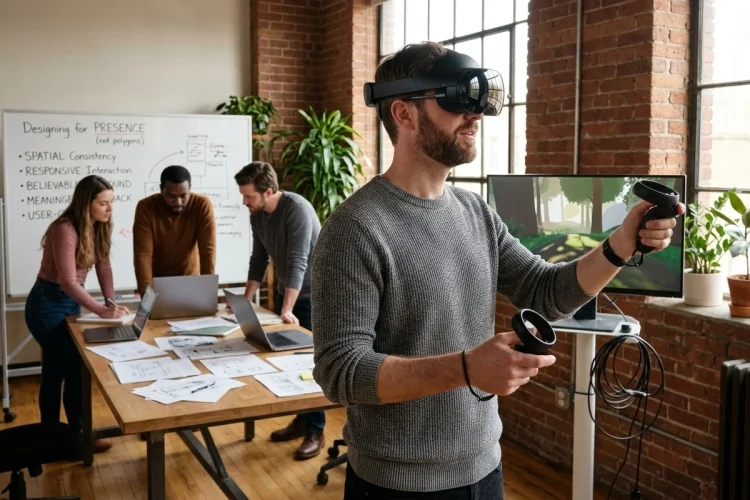
A virtual world can contain millions of polygons, realistic reflections, and incredibly detailed textures yet still feel strangely artificial. Meanwhile, a visually simple environment can sometimes make users forget about the technology within minutes.
That difference comes down to presence. When Designing Immersive Media, visual complexity should support the feeling of “being there,” not become the goal itself.
Spatial consistency, responsive interaction, believable sound, and meaningful reactions often matter more than adding another layer of graphical detail.
The strongest immersive experiences make technology disappear from attention so people can focus on the world around them.
Presence Is Different From Visual Realism
Presence describes the psychological feeling of being located inside a mediated environment rather than merely looking at it.
Mel Slater’s influential research separates this experience into concepts such as place illusion-the sensation of actually being somewhere-and plausibility, which relates to whether events in that environment seem to be genuinely happening.
This distinction matters because neither idea requires photorealistic graphics.
A stylized forest can generate strong presence if looking around feels natural, objects respond logically, sounds come from believable locations, and the world consistently acknowledges the user.
A photorealistic forest with broken interactions may do the opposite.
Build Sensorimotor Coherence Before Adding Detail
Presence becomes stronger when what people see matches what their bodies expect.
Turn your head and the environment should follow correctly. Reach toward an object and its position should remain stable. Move your hand and the virtual representation should respond without distracting delay.
Slater’s framework connects place illusion closely with sensorimotor contingencies-the relationship between bodily action and sensory feedback generated by the system.
This means development teams should prioritize tracking, movement, scale, collision behavior, and interaction consistency before adding expensive visual decoration.
A beautifully rendered door that cannot be opened may remind users that they are inside software. A simple door that moves naturally when pushed can strengthen the experiance.
Use Only the Visual Detail That Supports the Scene
Visual complexity is useful when it communicates something.
Texture, lighting, animation, particles, environmental objects, and character detail can establish atmosphere or direct attention. Problems begin when teams add complexity simply because the hardware can render it.
Apple’s spatial design guidance makes a surprisingly practical point: developers do not need to reproduce every detail of a real theater to communicate the feeling of being inside one. Instead, designers can focus on the key elements that create immersion.
Think about a virtual mountain cabin.
The exact number of wooden scratches on a table may contribute little. The sound of wind outside, subtle firelight, believable scale, and a window revealing the landscape may contribute much more.
Presence comes from meaningful cues working together.
Spatial Audio Can Carry More Immersion Than Extra Geometry
Immersive design is often discussed visually, but people continuously use sound to understand space.
A noise behind the user suggests something exists outside their current field of view. Footsteps communicate distance. Reverberation suggests room size, while subtle environmental audio can make a static scene feel alive.
Apple describes sound as crucial to compelling spatial experiences and recommends spatially positioning audio cues so interactions seem connected to the objects producing them.
Imagine picking up a virtual metal tool.
A perfectly modeled object with generic stereo audio can feel flat. A simpler model paired with accurate positional sound and appropriate material feedback may feel far more convincing.
Audio is therefore not decoration added after visual production. It is part of spatial world-building.
Make the Environment Acknowledge the User
A world feels more believable when it notices that someone is inside it.
Characters can look toward the user. Objects can react to touch. Surfaces can respond to movement. Environmental events might happen because the participant entered a certain area.
Plausibility research suggests that believable responses are partly influenced by whether virtual events relate appropriately to the participant’s presence and expectations.
This can be remarkably simple.
A virtual character turning their head when someone approaches may add more presence than dramatically increasing facial texture resolution.
The important question becomes: “Does this world respond to me?”
When the answer is yes, users can begin treating the enviroment as a place instead of a rendering.
Preserve Comfort and Orientation
Maximum immersion is not always the best design choice.
People need time to understand where they are, how interaction works, and what the system expects from them. Immediately covering the entire visual field with intense motion can create confusion instead of presence.
Apple recommends providing only the amount of immersion needed and, in many cases, allowing users to orient themselves before entering a fully immersive experience.
Ground planes, stable horizons, readable scale, comfortable content placement, and predictable movement all help users build a spatial model of the experience.
This is particularly important when designing extended sessions.
Presence should feel natural rather than demanding constant physical effort.
Design Interaction Until the Interface Disappears
One sign of successful immersive design is that users stop thinking about the controller or interaction system.
A longitudinal VR study found that participants became more comfortable with the technology over repeated sessions and described interaction as increasingly natural. Some reported becoming less consciously aware of the mediation itself.
That insight has practical implications.
Avoid requiring people to remember complicated gestures when simpler movements would work. Keep object behavior consistant. Place interactive controls where users can discover them naturally.
Every moment spent thinking, “Which button do I press?” is attention pulled away from the immersive world.
Good interaction design does not call attention to itself.
Test Presence, Not Just Screenshots
Traditional visual reviews are useful, but screenshots cannot reveal whether an immersive experience actually works.
Teams should watch people enter the space, explore, interact, and react. Do they naturally look toward sounds? Do they reach for objects without instructions? Do they avoid virtual obstacles instinctively?
Those behaviors can reveal more than raw graphical benchmarks.
Presence research also shows that spatial presence, agency, embodiment, plausibility, and sensory cues interact in complex ways rather than depending on one single factor.
Therefore, testing should evaluate the whole experience.
Instead of asking whether an environment looks realistic, ask whether users behave as though the world matters.
Designing Immersive Media around presence means prioritizing coherent interaction, spatial sound, believable reactions, comfort, and meaningful visual cues before increasing graphical complexity.
Photorealism can enhance an experience, but it cannot repair a world that feels unresponsive or inconsistent.
Start your next immersive project by identifying the moments that should make users feel genuinely present, then build every technical and creative decision around them.