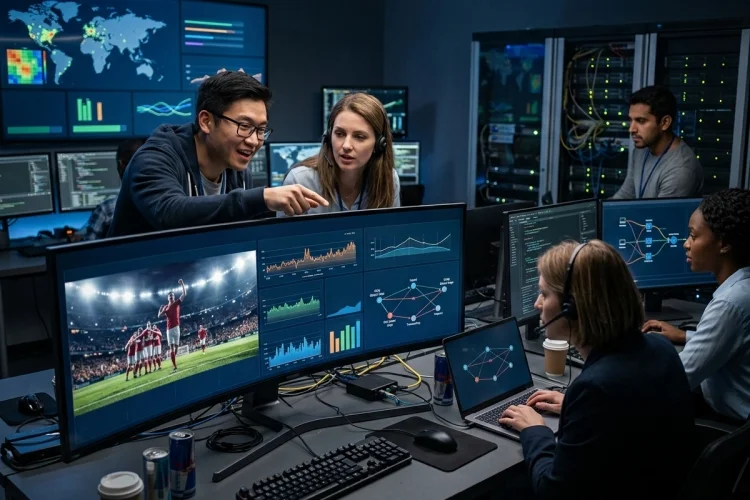
A live stream can look perfectly smooth and still feel strangely disconnected. If viewers see a goal, auction result, or audience poll several seconds after it happens, interaction starts feeling artificial.
That is where Advanced Low-Latency Architecture becomes important. The goal is not simply pushing latency as close to zero as possible. Successful systems balance delay, buffering, video quality, CDN scale, and network reliability.
For interactive broadcasts with large audiences, technologies such as Low-Latency HLS and CMAF can reduce delay while preserving the HTTP infrastructure that makes global streaming practical.
Start With an End-to-End Latency Budget
Latency is not created by one component.
Camera capture, encoding, ingest, transcoding, packaging, CDN delivery, player buffering, decoding, and display all add small amounts of delay.
Amazon IVS defines end-to-end latency as the time between camera capture and the stream appearing on the viewer’s screen.
Its managed low-latency channels can deliver video at under five seconds, while its real-time stages can go below 300 milliseconds for more interaction-sensitive scenarios.
That difference shows why teams need a latency target before choosing technology.
A large concert stream with chat may work well at a few seconds. A remote game show where viewers compete with the host may need substantially less.
Break the target into component budgets.
If your total goal is three seconds, allowing the player alone to buffer six seconds obviously makes the rest of the optimization irrelevant.
Use Partial Segments to Publish Media Earlier
Traditional HTTP streaming waits for relatively large media segments to become available.
Waiting improves efficiency and stability, but it also adds delay.
Low-Latency HLS changes this through partial segments. Apple explains that LL-HLS can divide normal media segments into much smaller pieces, allowing them to be packaged and published before the full parent segment is complete.
For example, a regular segment might represent several seconds of video while partial segments represent only fractions of a second.
The viewer can begin receiving new media much closer to when it was produced.
This is one reason CMAF-style chunking is so important for low-latency HTTP delivery.
DASH implementations use a similar principle. dash.js documentation describes low-latency delivery using CMAF chunks and notes that reducing the live delay can bring playback closer to the live edge, although smaller buffers also provide less protection against unstable networks.
Low latency is therefore not simply “make segments smaller.”
It is a system-wide buffering decision.
Make Playlist Updates Faster
Publishing smaller media pieces does not help much if the player discovers them too late.
Classic live HLS clients periodically reload playlists to discover newly available segments. That polling behavior can add unnecessary waiting.
LL-HLS introduces blocking playlist reload.
Instead of repeatedly asking whether new media exists, the player can request a future playlist update.
The server holds the request until the requested media becomes available and then responds immediately. Apple describes this as a way of eliminating inefficient playlist polling and reducing segment-discovery delay.
Preload hints push this further.
The server can tell clients which partial resource is expected next, letting them request it before production has completely finished.
These mechanisms may sound small individually.
Together, they remove repeated round trips from a latency-sensitive delivery path.
Keep the CDN in the Architecture
One mistake is assuming low latency requires abandoning CDN delivery.
For massive one-to-many entertainment events, that can create serious scalability problems.
Apple designed Low-Latency HLS specifically to preserve HLS’s ability to operate over ordinary HTTP infrastructure and CDNs.
Features including unique playlist-update URLs, blocking reload, partial segments, and appropriate cache behavior allow low-latency delivery to continue benefiting from edge distribution.
This makes LL-HLS especially attractive when the audience can grow from thousands to millions.
The origin should not suddenly receive one request from every viewer just because the experience needs lower delay.
Configure caches carefully, though.
Low-latency manifests behave differently from ordinary long-lived VOD objects. Request coalescing, query-string handling, cache policies, and stale responses can all affect performance.
A poorly configured CDN can turn elegant low-latency packaging into a slow experiance.
Tune Keyframes With the Latency Goal
Encoder configuration matters before media ever reaches the CDN.
Keyframe intervals influence startup, segment boundaries, rendition switching, and recovery.
Amazon IVS recommends one- or two-second keyframe intervals for its low-latency workflows.
It also notes that moving from two seconds to one second can reduce startup delay, but shorter intervals introduce QoS tradeoffs such as more frequent adaptive-bitrate switching and potentially increased buffering.
This is a good example of a broader architecture principle.
Every reduction in latency has a cost somewhere.
More frequent keyframes can increase bitrate overhead. Smaller media chunks generate more requests. Less buffering reduces tolerance for network instability.
The correct setting is rarely the smallest number available.
Tune using real playback measurements rather than simply minimizing every parameter.
Let Adaptive Bitrate Protect the Experience
Interactive streaming still needs adaptive bitrate.
In fact, it may need good ABR logic even more because the smaller playback buffer gives the player less time to recover from changing bandwidth.
When throughput falls, the player should switch to a sustainable rendition before the buffer reaches zero.
LL-HLS includes rendition reports that help clients switch among different bitrate renditions with fewer unnecessary round trips.
DASH low-latency implementations similarly combine live-delay control with adaptive playback.
The goal is not maintaining maximum resolution at all times.
A temporary quality reduction is usually less damaging than a frozen live interaction.
If viewers see a sharper image but miss the poll deadline because the video buffered, the architecture optimized the wrong thing.
Quality and latncy need to be evaluated together.
Synchronize Video With Interactive Events
Low-latency video alone does not guarantee an interactive experience feels synchronized.
Suppose video arrives three seconds behind real time while chat messages appear almost instantly.
The audience may react to events before other viewers have actually seen them.
Polls, scores, auctions, trivia answers, overlays, and live commerce events can suffer from the same mismatch.
Architecture should therefore measure media latency and data-channel latency separately.
Where necessary, application events can be intentionally delayed or timestamped so they correspond with the viewer’s current position in the live stream.
This is particularly important when audience latency varies.
One viewer may be two seconds behind while another is five seconds behind because of local network conditions.
Event synchronization should follow media time when correctness matters.
Otherwise “low latency” can still feel badly syncronized.
Measure Latency From the Viewer
Backend timing is useful, but the viewer experiences the whole chain.
Measure time to first frame, glass-to-glass delay, rebuffering, bitrate switches, playback errors, live-edge distance, and recovery after temporary network loss.
Amazon notes that observed latency varies based on broadcaster and viewer geography, network conditions, streaming protocols, and components across the delivery chain.
That means average server latency is insufficient.
Break measurements down by ISP, country, device, connection type, and player version.
A configuration that works beautifully on office fiber may perform poorly on mobile networks with variable throughput.
The best low-latency system is not the one producing the lowest laboratory number.
It is the one staying predictably close to live for real viewers.
Advanced Low-Latency Architecture should reduce delay without destroying the stability that makes streaming enjoyable.
LL-HLS, CMAF chunks, efficient playlist updates, CDN caching, encoder tuning, and intelligent buffering all contribute to the final result.
Define the interaction requirement first, then optimize each stage against a measurable latency budget rather than chasing the smallest theoretical delay.