A level number going up can feel satisfying, but it rarely carries an entertainment platform for years.
Modern players may be improving mechanical skills, unlocking content, developing characters, building collections, completing stories, and earning social recognition at the same time.
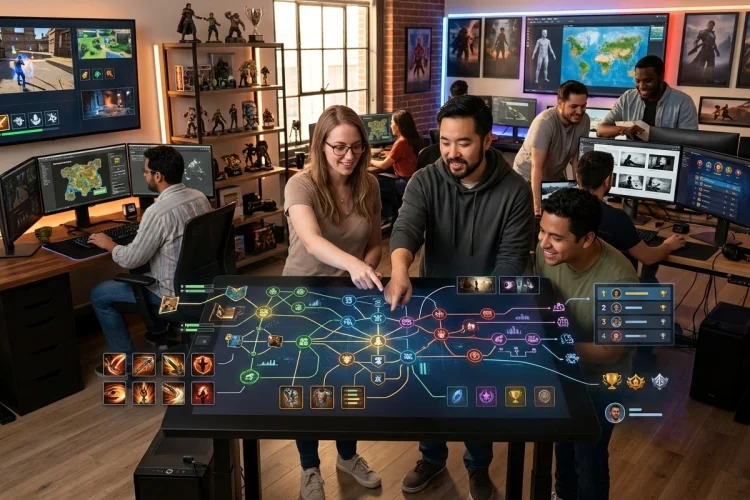
That is where Advanced Progression Systems become useful. Instead of relying on one endless XP bar, they organize different kinds of growth into connected layers.
The goal is not to make players grind forever. It is to make progress remain understandable, rewarding, and flexible as the experience becomes more complex.
Build Progression as a Layered System
Complex entertainment platforms usually need more than one progression track.
Research on commercial video games identifies several common forms of progression, including skill-based, XP-based, item-based, narrative, social, and hybrid structures.
The important point is that these systems serve different purposes rather than simply measuring the same activity in different ways.
Imagine an online action game. Account level might represent overall experience, weapon mastery shows specialization, story chapters track narrative advancement, while a ranked tier reflects competitive performance.
These layers should complement each other.
If every system rewards exactly the same behavior, the platform becomes repetative. A healthier structure lets one player pursue mechanical mastery while another focuses on collection, exploration, or social achievement.
Give Every Track a Clear Meaning
Players should immediately understand what each progression layer represents.
“Account Level 73” may indicate time and broad experience. “Master Archer” should communicate specific accomplishment.
Clear meaning makes progression easier to value.
Pace Early and Late Progress Differently
Early progression has an important teaching job.
New users are still learning controls, systems, terminology, and goals. Frequent milestones can reassure them that they understand how advancement works.
Later progression should usually become deeper rather than merely slower.
Increasing the XP requirement from 10,000 to 10 million without introducing meaningful new goals creates grind. Advanced players need harder objectives, specializations, prestige challenges, or new forms of mastery.
Microsoft’s achievement guidance similarly treats achievements as a mechanism for directing and rewarding in-game actions and helping users experience more of a title.
Progression pacing should therefore guide exploration, not simply extend playtime.
Connect Progress With Real Mastery
Numbers feel strongest when players can connect them to improved capability.
Research applying Self-Determination Theory to video games has repeatedly linked perceived competence and autonomy with enjoyment and future play. One influential set of studies also found relatedness important in multiplayer settings.
This gives progression designers a useful target: help players feel more capable, not merely more decorated.
Consider a racing game.
Instead of rewarding players only for completing 100 races, progression could recognize clean overtakes, mastery of different tracks, improving lap consistency, or winning under difficult conditions.
The player then develops both an account and a skill identity.
That connection between visible progress and genuine improvement can remain satisfying much longer than automatic XP accumulation.
Make Rewards Change What Players Can Do
Rewards do not always need to be more powerful items.
Sometimes the best progression reward is additional possibility.
Completing a challenge might unlock a new playstyle, customization layer, side activity, creative tool, character route, or advanced difficulty option. These rewards make progression feel like expansion rather than payment for repetition.
Xbox achievements, for example, can expose progress toward requirements, while achievement rewards can include system-level score, digital artwork, or in-app rewards depending on implementation.
The broader principle is to vary reward types.
Currencies work for economic progression. Cosmetics support identity. Content unlocks provide discovery. Titles and achievements can communicate accomplishment.
Using the same reward for everything eventually makes that reward feel ordinary.
Protect Autonomy With Multiple Progress Paths
A complex platform should avoid telling every player to progress in exactly the same way.
Self-Determination Theory emphasizes autonomy alongside competence and relatedness. In games, these psychological needs have been associated with enjoyment, engagement, and positive player experience.
Progression design can support autonomy by offering alternative goals.
A cooperative player might earn advancement through team support. A competitive player may prefer ranked challenges. Explorers can pursue discoveries, while collectors work toward complete sets.
The underlying platform can still have shared milestones, but users have some control over how they reach them.
This also reduces the feeling that progression is a checklist.
When every player is following the exact same path, advancement can become predictable. Choice creates a stronger sense of personal ownership.
Use Social Progression Carefully
Social progression can add another dimension to long-term growth.
Titles, guild roles, reputation, team achievements, seasonal rankings, and visible mastery can communicate status inside a community.
But competition is not automatically motivating.
Research using Self-Determination Theory suggests that competition can support or undermine motivation depending on how it is structured.
Systems focused heavily on controlling comparison may frustrate psychological needs, while healthier competitive contexts can support competence and meaningful challenge.
This means leaderboards should not become the only definition of success.
Consider adding cooperative milestones, mentoring recognition, community contribution, or group accomplishments alongside competitive rank.
A platform feels richer when there are several ways to become respected.
Social progression should communicate identity, not create permanent anxiety about falling behind.
Measure Progression Quality, Not Just Completion
A progression dashboard can show how quickly players move through levels, but speed alone tells little about quality.
Track where progression stalls, which rewards players actually use, which paths they choose, and whether milestones correspond with continued participation.
Xbox’s achievement system, for example, can expose progress toward individual achievement requirements rather than reporting only locked or unlocked states.
For internal analytics, go further.
If most players abandon a progression track at level 14, investigate why. The requirement may suddenly become too demanding, the next reward may look weak, or users may not understand what to do.
Also watch how different progression systems interact.
A competitive path should not accidentally make narrative advancement irrelevant. A crafting system should not completely undermine item rewards earned through difficult play.
Advanced progression requires ongoing maintainance because changes in one layer can reshape the value of another.
Advanced Progression Systems work best when growth feels layered, understandable, and connected to genuine mastery.
Combine different progression types, pace them according to player experience, preserve autonomy, and make rewards expand meaningful possibilities.
Start by mapping every progression track in your platform and ask what each one actually tells players about how they have grown.